The Problem Nobody Talks About Until It’s Their Block
There are over 1.6 million parcels in the United States that the government owns outright because of tax foreclosure or abandonment. Most of us drive past them without thinking. They’re the weedy lots with chain-link fencing, the houses with boarded windows, the dead space between your commute and wherever you’re actually going. But in 15 post-industrial metro areas — Detroit, Cleveland, Baltimore, Gary, and others — these aren’t scattered anomalies. They’re concentrated clusters. Whole neighborhoods where one in four or one in five properties sits vacant, owned by nobody in particular, managed by nobody at all.
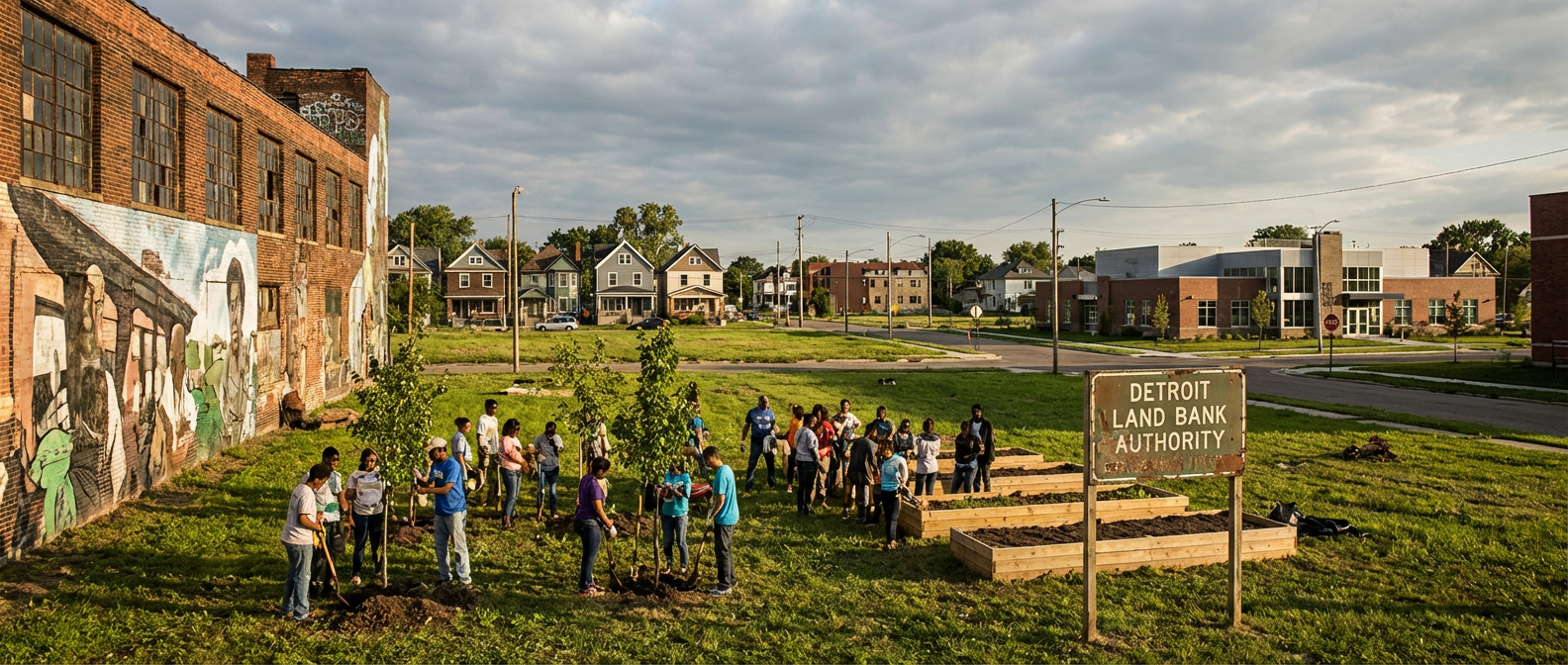
The standard civic response used to be resignation. The properties were expensive to maintain. Nobody could figure out who was responsible. Banks didn’t want them. Developers couldn’t make the numbers work. So they sat. Year after year. They became dumping grounds. They attracted crime. Property values on adjacent blocks tanked. It was a cascade failure, one empty lot making the next one more likely to fail.
Then Detroit did something different.
Detroit’s Gamble: The Land Bank Model That Actually Works
In 2008, while the rest of the country was asking how to save the auto industry, Detroit was asking a different question: what do we do with a city half full of abandoned property? The Detroit Land Bank Authority was created to consolidate those scattered government-owned parcels into one organized inventory. Instead of leaving them in limbo across multiple city departments, they’d have one focused entity managing them.
The core idea was simple but powerful. Speed up the process of transferring properties from government ownership to people who’d actually use them. Remove the friction. Make it possible for community organizations, small developers, and ordinary residents to acquire property they could fix and keep. By 2024 alone, the Detroit Land Bank transferred over 5,200 properties to community and private ownership. That’s real change. It’s also not abstract — those transfers generated an estimated $28 million in new property tax revenue for Detroit Public Schools. Empty lots don’t pay taxes. Properties in use do.
What started as Detroit’s survival strategy became a national blueprint. Cities everywhere started asking: could we do this too? They found out the answer was yes, but only if you actually committed to the work. The Land Bank model isn’t passive management. It requires staff, process discipline, and partnership with communities. It requires treating vacant property not as a permanent condition but as a temporary problem with a solution.
The Science Behind the Greening: What Happens When You Fill the Emptiness
You can talk about property values and tax revenue, and those numbers matter. But here’s what got people really paying attention: a 2025 study from the Federal Reserve Bank of Philadelphia tracked what happened when they strategically converted vacant lots into green space. Gun violence within 250 feet of treated lots dropped by 29 percent. Resident-reported stress levels declined measurably. Emptiness isn’t just an economic problem. It’s a social problem and a public health problem.
Syracuse, New York proved this with concrete results. Their Land Bank took 340 formerly blighted parcels and converted them into community gardens and urban agriculture sites. Those gardens now supply produce to 14 local food pantries. That’s 340 small victories that compound. People who live near those gardens know what they represent. They’re not just prettier than rubble. They’re functional. They produce food. They create gathering places. They signal that someone is paying attention to the neighborhood.
This is where the Land Bank movement stops being just about real estate and becomes about dignity. When you walk down a block where lots are managed and maintained instead of abandoned, you feel different. The street says: we care about this place. Someone is responsible. This neighborhood isn’t being written off. That matters more than policy documents can usually capture.
Congress Finally Showed Up: New Money and Political Momentum in 2025-2026
For years, the tools available to cities and nonprofits trying to rehabilitate property in distressed neighborhoods were limited. The Low Income Housing Tax Credit existed, but it couldn’t address a specific problem: when properties were valued so low that the cost of rehabilitation exceeded the final property value, the numbers simply didn’t work. There was a gap nobody had solved.
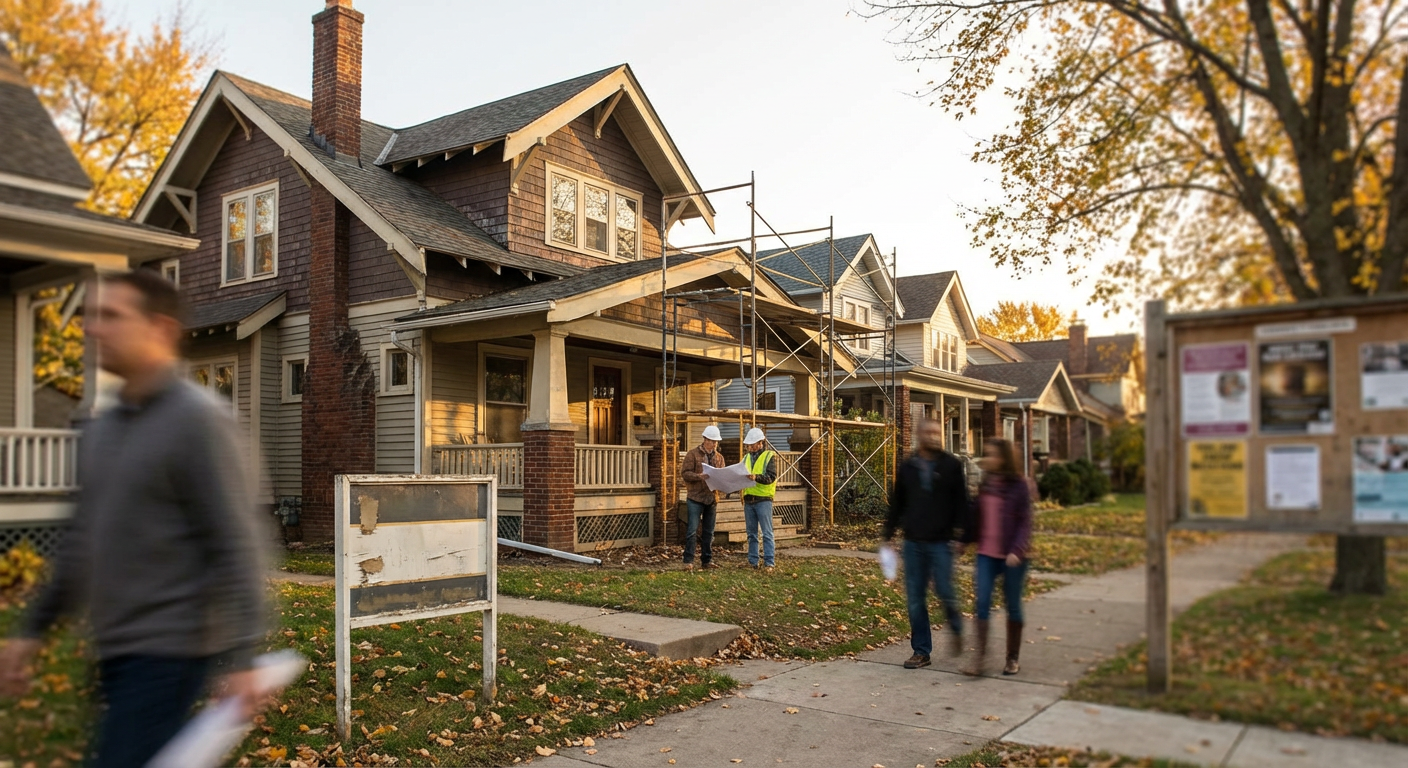
In late 2025, Congress passed the Neighborhood Homes Investment Act as a standalone bill. It created a new tax credit specifically designed to target this gap: rehabilitation of homes in distressed census tracts where the property value fell below local construction costs. It sounds technical. It is. But it means cities now have a federal tool that actually matches their actual problem. Land Banks and community development organizations can now tackle properties that would have been economically impossible to restore three years ago.
This is how change happens at scale. It’s not one dramatic gesture. It’s a Land Bank system developed in Detroit, refined in other cities, documented by organizations like the Center for Community Progress Land Bank Resources, then finally supported by federal legislation. Each step was built on evidence from the previous step.
What It Actually Takes: The Work Behind the Transformation
I want to be clear about something. Land Banks work, but they’re not magic. They require real organization, real staffing, and real community partnership. Detroit didn’t transfer 5,200 properties in 2024 by accident. Someone had to process each transfer. Someone had to coordinate with nonprofits. Someone had to manage the properties between acquisition and transfer. It’s not complicated work, but it is deliberate work.
When a community organization in Philadelphia or Syracuse or Cleveland decides to participate in the land bank process, they’re taking on responsibility. They’re saying: we will maintain this property. We will develop it productively. We will prove that land banking actually works when communities show up. That commitment is the secret ingredient that makes the whole system work. The Land Bank provides structure. Communities provide care.
In 2026, this is no longer a Detroit experiment. It’s a network. It’s becoming the standard approach in post-industrial cities. The Neighborhood Homes Investment Act Coalition now coordinates both the policy side and the ground-level implementation across dozens of metro areas.
Your Block, Your City: Where This Goes From Here
The vacant lot revolution didn’t happen because economists published papers. It happened because people in cities decided to do something about the empty space around them. Someone noticed a lot. Someone proposed a garden. Someone else asked why their city didn’t have a Land Bank like Detroit did. That person pushed. Others listened. Things changed.
If you live in a post-industrial city, you probably know exactly which lot I’m talking about. The one that’s been empty for years. The one that makes the whole block feel sad. Find out if your city has a Land Bank. If it does, find out how to propose a project. If it doesn’t, find out why. Read the city council minutes. Ask questions. Show up. That’s not metaphorical advice. That’s the actual method that’s working in cities across the country right now. The framework exists. The tools exist. The question is whether your community is ready to use them.