The Numbers Nobody Talks About Over Coffee
So I was reading the latest demographic surveys the other day, the kind that normally make people’s eyes glaze over, and something jumped out that’s worth actually discussing. Since 2007, the number of Americans who identify with no religion has more than doubled, climbing from 16 percent to over 30 percent of adults. That’s not a minor shift. That’s a reconfiguration of how entire communities are structured, whether we acknowledge it or not.

The thing is, most people treating this as breaking news are either celebrating it as progress or mourning it as decline. Both reactions miss something crucial. The real story isn’t about whether organized religion is good or bad. It’s about what happens to the actual work of community when the institutions that were handling it start operating with fewer people and fewer resources. Churches, synagogues, mosques, and temples weren’t just places where people got spiritually sorted. They were the infrastructure of neighborhood life.
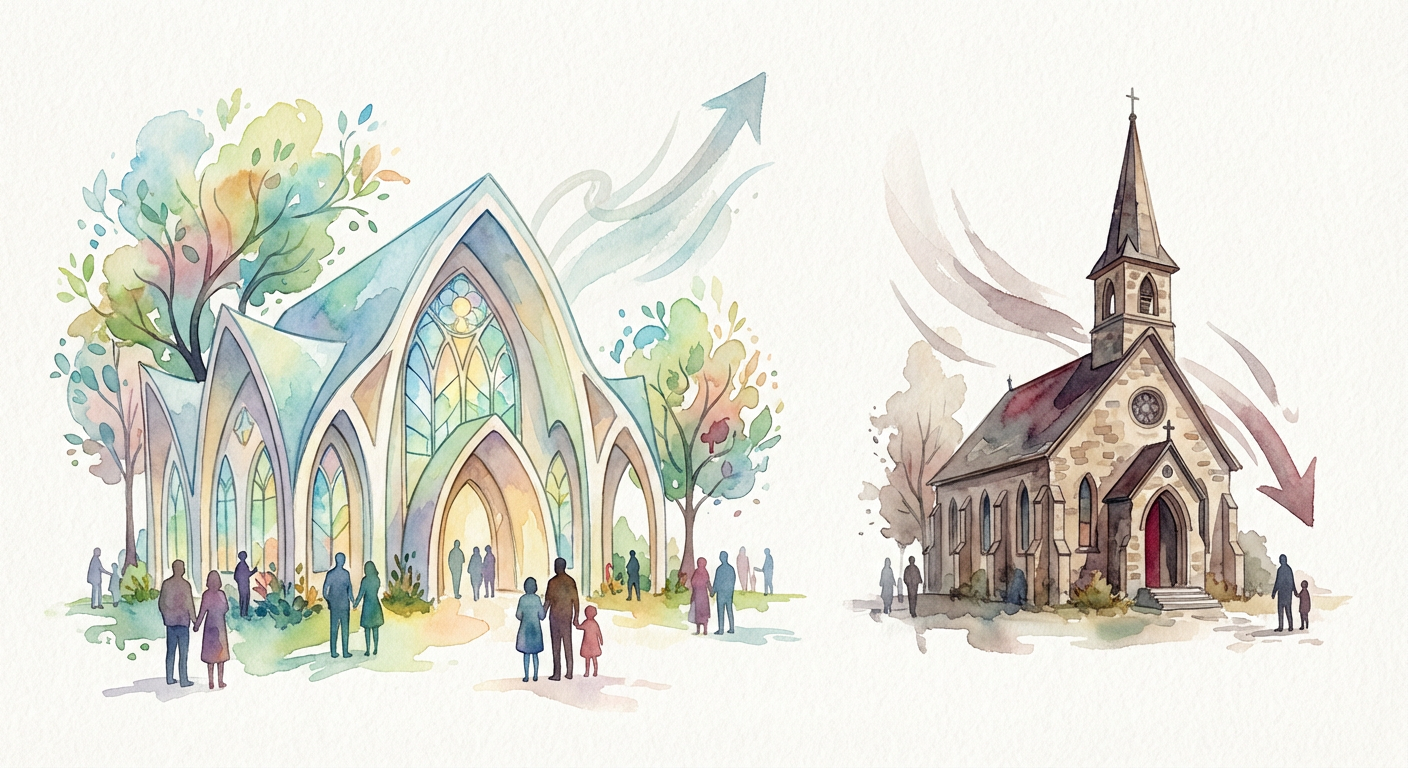
What Religious Communities Actually Do (Beyond What You Might Think)
Let me be specific about this, because vague sentimentality helps nobody. When a faith community operates at full strength in a neighborhood, it’s not just providing meaning and ritual. It’s providing the connective tissue that cities otherwise have to purchase as separate services. A midweek soup kitchen isn’t just feeding people. It’s creating the repetition and relationship that makes someone feel known. A youth group isn’t just keeping teenagers busy. It’s creating accountability and mentorship across economic lines. A community garden run by a congregation isn’t just growing vegetables. It’s creating reasons for different generations to work alongside each other.
Most secular alternatives handle these things separately, if they handle them at all. You contract with a nonprofit for meals. You enroll kids in programs. You join a community garden group through an app. These are real services, and I’m not being sentimental about some imagined past. But they require separate funding streams, separate sign-ups, separate infrastructure. What faith communities provided, often for free or on a sliding scale, was a bundle of social infrastructure all housed in one place and held together by something deeper than a program budget.
Research on this actually backs it up, even if it doesn’t make headlines. Faith-based organizations still lead on housing advocacy, immigration support, and anti-poverty work, especially when they connect across different traditions. Interfaith coalitions have become some of the most effective organizing infrastructure in cities precisely because they bring together people with different theological commitments but shared commitment to neighbors. These aren’t sentimental holdovers. They’re doing what secular alternatives haven’t figured out how to scale.
The Quieter Shift: Who’s Actually Growing
Here’s where it gets interesting, and where the story gets more complicated. While overall religious affiliation is declining, the picture isn’t uniformly grim. Progressive religious spaces, places genuinely wrestling with questions about justice and inclusion, are actually growing. Meanwhile, some of the more rigid conservative denominations are shrinking. That’s important context.
The fastest growing category now is people who identify as spiritual but not religious. They’re not abandoning the search for meaning. They’re abandoning institutions. And honestly, you can understand why. If your experience of organized religion was narrow, judgmental, or disconnected from values you actually care about, the exit door makes sense. But what you’re left with is meaning without structure, conviction without community, spirituality without any obligation to neighbors who aren’t you.
Something else happened during COVID that we should pay attention to. When churches moved online, some people discovered they actually preferred it. About 40 percent of the attendance that shifted online stayed online even after buildings reopened. For some people, that was access they needed. For many others, it was convenience that turned into disconnection. You can watch a service alone. You cannot build a neighborhood with people you never actually meet.
The Real Work: What It Actually Takes
Three years ago, I watched a local interfaith group tackle housing in our neighborhood. It started small. Some rabbis, a few Protestant pastors, an imam, and a Buddhist meditation teacher who’d been thinking about social engagement as spiritual practice. They could have met once a month and felt virtuous. Instead, they did the boring part. They attended city council meetings. They learned housing policy. They got frustrated with zoning regulations that nobody had paid attention to in twenty years. They talked to secular nonprofit leaders and academic researchers. They brought in people from affected communities, especially renters who’d been pushed out or were about to be.
What they built wasn’t flashy. It was a coalition that could show up consistently at planning meetings, speak authoritatively about both their values and the actual logistics, and bridge between their congregations and secular advocacy organizations. The faith communities brought moral clarity and consistent bodies. The secular groups brought policy expertise and data. Neither alone would have moved the needle. Together, they actually changed some zoning code language that affected how housing got developed.
That’s the template, if we’re serious about this: not faith communities operating separately from the actual work, but faith communities as essential partners in it. And it only works if those communities stay grounded in their actual neighborhoods instead of becoming increasingly private and internal.
What Gets Lost When We Pretend This Doesn’t Matter
I know plenty of people who left organized religion for excellent reasons. The institutional baggage is real. The scandals are real. The judgmentalism is real. And yet, when fewer people are embedded in communities rooted in something larger than individual preference, we lose something. We lose some of the scaffolding that made mutual aid feel natural rather than transactional. We lose some of the reasons to show up consistently for people who aren’t in our demographic or income bracket.
You can look at Pew Research religion data and see the decline. You can read Religion News Service for ongoing coverage of what this means. But the real question is what we build to replace it if we’re serious about community. Right now, the answer seems to be: we’re making it up as we go. Some nonprofits. Some government programs. Some volunteering among people who already have resources. Some very expensive market solutions for things that used to be provided through relationship.
If you’re in a faith community that’s actually trying to engage with these questions, show up. If you’ve left organized religion but care about neighbors, find ways to plug into the interfaith work happening in your city. If you’re building secular infrastructure for community, talk to the faith leaders in your neighborhood instead of pretending they’re irrelevant. The work of holding communities together isn’t going to get easier. It’s going to require every resource we have.